
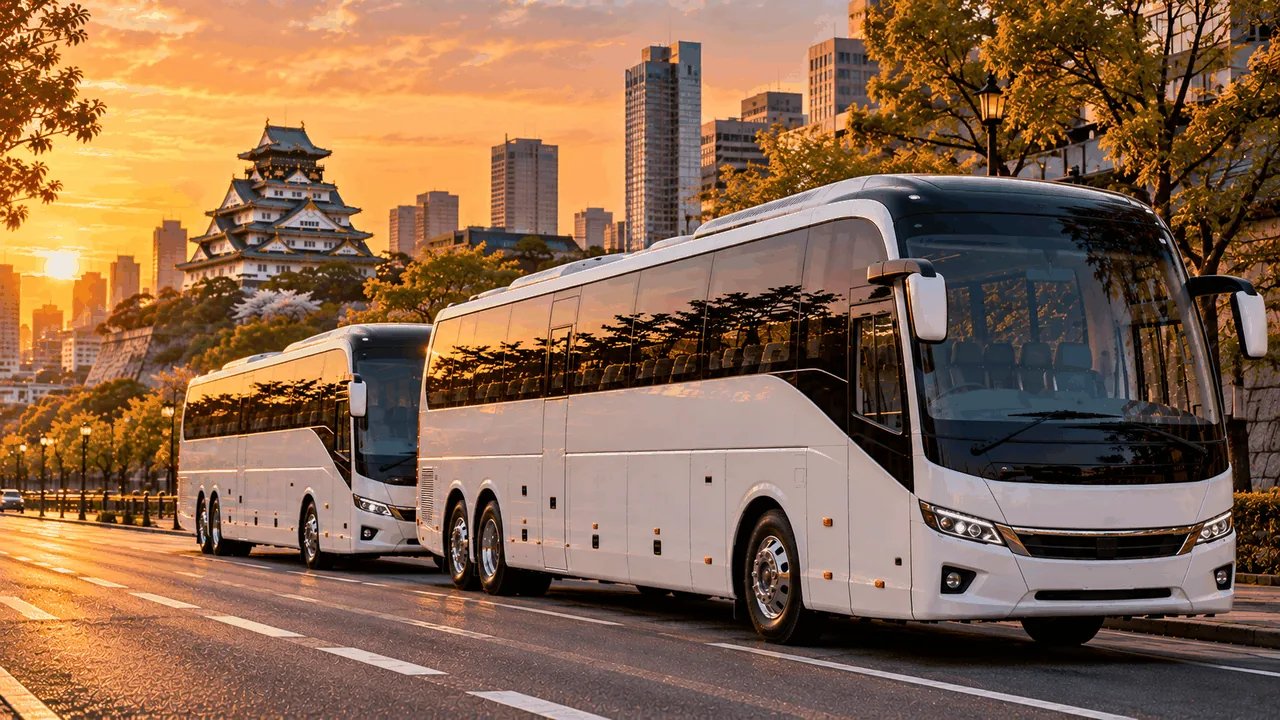
73–100 Seater Group Transport Osaka group transport planning
The multi-vehicle group transport category is designed around a nominal capacity of 73–100 passengers and is commonly requested for large groups normally requiring coordinated vehicle allocation. Private transport is most useful when a group needs to move together, keep luggage with the same party, follow a fixed programme or connect several stops that are awkward to manage independently. For 73–100 Seater Group Transport Osaka, the planning starts with passenger count, luggage volume, exact pickup point, destination, travel date and the timings that cannot move. The vehicle category should then be matched to the whole journey rather than selected only from the headline seat number.
Typical requests include large groups normally requiring coordinated vehicle allocation, plus direct transfers, hotel pickups, rail connections and private itineraries where the group prefers to travel together. Osaka is a dense metropolitan area with busy rail hubs, commercial districts and visitor zones, so a workable itinerary should distinguish between a place where a coach can legally stop, a place where passengers want to visit, and a place where a vehicle can wait. Those are not always the same location. For large groups, advance coordination of meeting points and loading windows can make a bigger difference than choosing a larger vehicle.
Choosing the right vehicle
The site uses a capacity-led range from cars and MPVs through minibuses, mid-size coaches and full-size coaches. Exact makes, models, luggage holds and onboard equipment vary by the vehicle assigned to the journey. If the group has large suitcases, sports equipment, mobility aids, exhibition materials or unusually bulky baggage, that should be stated before confirmation. A nominal seat count does not guarantee that every occupied seat can be combined with large luggage for every passenger.
For 73–100 Seater Group Transport Osaka, small groups may prefer an MPV or minibus because it is easier to coordinate at hotels and city pickup points. Medium groups often fit a mini coach or conventional coach. Large delegations may be better served by one large coach or by a planned multi-vehicle operation with separate passenger lists and a lead contact for each vehicle. Where the itinerary includes multiple hotels or venues, vehicle allocation can also be based on routing rather than group size alone.
Osaka access, timings and meeting points
For a 73–100-passenger allocation, passenger count and luggage must be considered together. Exact seating layout, boot or hold capacity, vehicle height and onboard specification vary by assigned vehicle.. Osaka traffic conditions vary by time of day, and station, airport, attraction and event access can involve designated boarding areas or short stopping windows. For that reason, quote requests should use the precise hotel, terminal, station exit, venue or street address whenever possible. A broad label such as “Osaka Station” or “Namba” may cover a large and complex area, while the correct side of a station or hotel can materially change the pickup plan.
For airports and rail connections, build the transport around the scheduled arrival rather than an optimistic city-centre travel time. International arrivals can require immigration, baggage collection and group assembly. Shinkansen parties can emerge from different gates if passengers are not briefed. Event groups may encounter pedestrian controls after a concert or match. A realistic plan includes buffer time and a clear contact method for the group leader.
Day hire and multi-stop itineraries
A private vehicle can be booked for a direct transfer, a block of local movements, a full-day programme or a multi-day tour. For 73–100 Seater Group Transport Osaka, a multi-stop itinerary should list stops in operating order with target arrival and departure times. This helps identify whether the same vehicle can remain with the group, whether driver-hour limitations need to be considered, and whether parking or repositioning is likely between visits.
Kansai itineraries frequently combine Osaka with Kyoto, Nara, Kobe, Himeji or other regional destinations. These journeys are practical by private coach for groups that want one vehicle and one luggage plan, but the itinerary still needs to allow for road conditions, rest requirements and attraction opening times. For multi-day work, overnight vehicle arrangements and driver accommodation requirements may also affect the quote.
What to include in the quote request
For an accurate vehicle hire quote, send the date, pickup location, destination, passenger count and desired pickup time. Add flight numbers, train details, luggage quantity, hotel names, venue schedules, return time, child-seat or accessibility requests, and every planned intermediate stop. For corporate or event work, include the number of rotations and whether passengers are divided into fixed groups.
Pricing should be reviewed against the complete itinerary. Tolls, parking, waiting, driver hours, overnight requirements and additional stops can affect the final transport cost depending on the assignment. Any quote should therefore be checked for what it includes rather than compared only as a headline number. If the itinerary changes, the transport plan should be rechecked before travel.
Booking 73–100 Seater Group Transport Osaka
Once the itinerary is clear, the booking can be matched to an appropriate capacity and operating plan. Keep one group leader available by phone or WhatsApp, circulate the pickup instructions before travel and avoid changing the meeting point at the last minute unless the transport coordinator confirms the new location. For 73–100 Seater Group Transport Osaka, this simple communication structure helps the group board efficiently and keeps the driver focused on the confirmed route.